

Monthly Series: Translator Tuesdays
Join us online on Tuesday, May 7th, for the third installment of our casual meet-up series. In this 1.5-hour meeting, Richard Sadowsky will lead a conversation on AI, translation, and its impact on the translation industry. Advanced registration required.
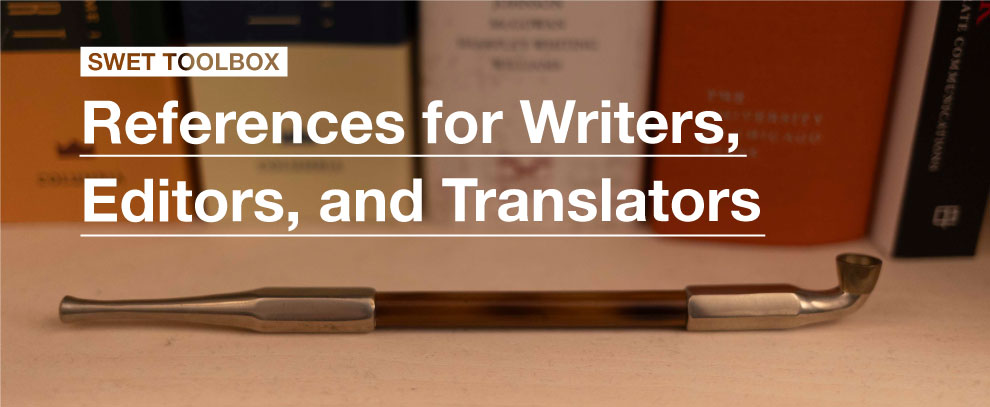
Japan Style Sheet: Further Reference Tools
Did you know that SWET maintains a growing list of reference tools on the Japan Style Sheet website? Click the image above to access links to dictionaries, thesauruses, glossaries, and other references for wordsmiths. If you know of a resource that belongs on the list, please let us know!
A Community for Japan-Related Writing Professionals
Based in Tokyo, Japan, SWET comprises people engaged not only in the three professions of writing, editing, and translating, but also in teaching, research, rewriting, design and production, copywriting, and other areas related to the written word in Japan.
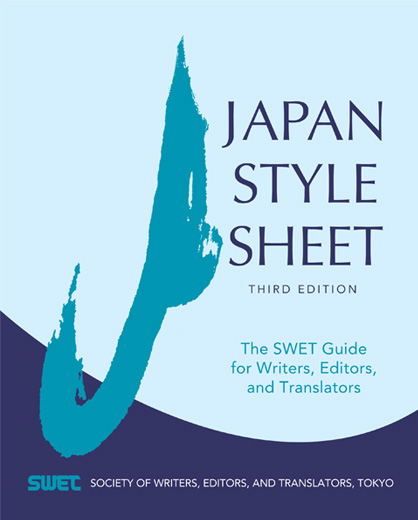
Japan Style Sheet
A cross-professional guide
The SWET Guide for Writers, Editors and Translators
News View all
IJET-32: International Japan-English Translators Conference
Dates: May 25–26, 2024 Location: Toronto, Canada
IJET-32 will be held in Toronto, Canada, on May 25–26, 2024. The theme is “Who knit ’ya? Who are we in the age of Chat-GPT?” Goals are to strengthen the connections within our translation/interpreting community and explore the impact that AI, such as Chat-GPT, has on our industry. More details about the venue, speakers, and registration at https://ijet.jat.org/ Also visit the Japan Association of Translators website for information on a wide... more
Swet Columns View all
EVENT REPORT: Owning Your Personal Brand
By Monique Bae
Tucked in the back of the bustling Book House Cafe in Jinbocho on March 29 were 10 people enjoying a two-hour workshop held by Ruth P. Stevens, a founding member of SWET and a globally recognized marketing professional and adjunct professor at NYU Stern. In “Building Your Personal Brand as a Freelance Professional,” Stevens provided tips on how to set ourselves apart and put a spotlight on the meaningful work we do.
1) She began by defining what a personal... more
Articles View all
If, for J-E Translators
If you can render prose in real English idiom While all about you Cling rigidly to translation word-for-word; If you can stand by natural wording Though clients claim they know better, But respect their sensibilities as far as conscience can; If you can grapple with obscurantism And articulate it in clear expository style; Or, being left with ambiguity, not perpetuate ambiguity, Or, given insider codes, not let cryptic phrases win the day. And yet not fear small expedients, Nor over-rate the laws of English logic.
If you can empathize—but not let passion... more
SWET Spotlight View all
Entering into the World I Created: Interview with Karen Hill Anton, author of “A Thousand Graces”
Karen Hill Anton is well known for her columns in the Japan Times, which she described in an article for SWET’s series on English-language newspaper columnists. Her memoir, The View From Breast Pocket Mountain, beloved by a wide readership, has earned three literary awards. She spoke to SWET about her memoir at length for a SWET Talk Shop in August 2021, available on YouTube, and again in October 2022 about the craft of memoir writing. Now... more
A Community for Japan-Related Writing Professionals
Based in Tokyo, Japan, SWET comprises people engaged not only in the three professions of writing, editing, and translating, but also in teaching, research, rewriting, design and production, copywriting, and other areas related to the written word in Japan.
Japan Style Sheet
A cross-professional guide
The SWET Guide for Writers, Editors and Translators
Join SWET-L, our mailing list
Check it out (non-members OK)
SWET Newsletter Archive
SWET Newsletter articles feature topics especially of interest to writers, editors, and translators and other wordsmiths connected with Japan.
 Facebook
 Twitter
 YouTube
 RSS
RSS